
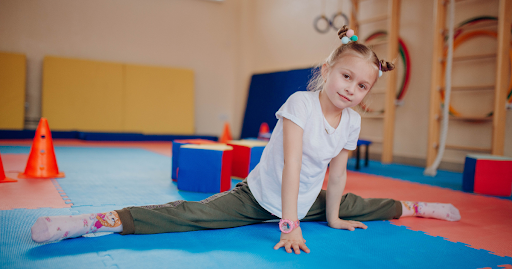
Parents have more choices than ever when deciding how to keep their children active. Soccer, dance, martial arts, swimming, baseball, and other activities can all contribute to a healthy childhood, but gymnastics has a distinctive advantage: it develops a broad foundation of movement skills that can support children both inside and outside the gym.
Calling gymnastics the “best” sport for childhood development does not mean it is objectively the right activity for every child. Children have different interests, abilities, personalities, and goals. What makes gymnastics especially valuable is the combination of balance, coordination, strength, flexibility, body awareness, perseverance, listening, and confidence that can be practiced within one structured activity.
For parents researching childhood development sports, gymnastics deserves serious consideration because children do more than learn routines or individual skills. They learn how to control their bodies, respond to instruction, work through challenges, and recognize their own progress. Those experiences help explain why the gymnastics benefits for kids can extend well beyond learning how to tumble, balance, jump, or swing.
Gymnastics introduces children to many fundamental movement patterns within the same activity. Young athletes practice balancing, jumping, landing, rolling, climbing, supporting their body weight, coordinating their hands and feet, and moving through space with greater control.
These experiences can create a useful physical foundation for children who remain in gymnastics as well as those who eventually move into other sports. At the same time, structured training gives children opportunities to practice patience, listening, perseverance, and confidence.
FlipZone’s own training philosophy emphasizes strength, coordination, perseverance, social skills, personalized instruction, and holistic athletic and personal growth. These priorities align closely with what many parents want from a developmental youth activity.
One of the strongest reasons parents choose gymnastics is the variety of movements children practice. Unlike activities centered primarily on running, throwing, kicking, or one repeated movement pattern, gymnastics challenges young athletes to use their bodies in many different ways.
Kids motor skills development includes learning how to balance, coordinate movements, change direction, control speed, stabilize the body, and understand where the body is in relation to the surrounding environment. Gymnastics naturally creates opportunities to practice these abilities through age-appropriate drills and progressions.
A child might move from balancing on a low surface to jumping and landing with control, then transition into a roll or another movement. Each activity asks the brain and body to work together differently. With repetition, children can become more comfortable managing increasingly complex movement patterns.
These foundational skills can also be useful outside gymnastics. Running on a playground, learning another sport, participating in physical education, climbing, jumping, and even navigating everyday physical challenges all require some combination of balance, coordination, strength, and spatial awareness.
Children do not need adult-style workouts to begin developing physical strength. Gymnastics provides many opportunities for children to use their own body weight while climbing, supporting, hanging, balancing, jumping, and maintaining different body positions.
That makes gymnastics a versatile form of youth fitness training when instruction is appropriate for the child’s age and ability. Instead of focusing on isolated exercise, children build strength while learning movement.
Core control, upper-body support, leg strength, and overall stability can all play roles in gymnastics skills. Children begin learning that strength is not simply about being powerful. It is also about controlling movement, maintaining position, and using the right amount of force at the right time.
FlipZone’s mission specifically includes helping students develop strength and coordination through personalized gymnastics training. Its program materials also emphasize structured instruction for children at different skill levels.
A major component of childhood physical development is learning how different parts of the body work together. A child may understand how to jump but still be learning where to place their arms, how to land, or how to maintain balance afterward.
Gymnastics gives children repeated opportunities to connect those pieces. They learn to coordinate their arms and legs, shift their weight, adjust body position, and respond to changes in direction or momentum.
This is one reason gymnastics can be particularly useful among childhood development sports. Children are not simply completing movements. They are becoming more aware of how their bodies move through space.
Better body awareness can also contribute to confidence. When children begin to understand what their bodies can do, unfamiliar physical activities may feel less intimidating. A child who has practiced balancing, landing, rolling, and changing direction may approach new movement challenges with greater comfort.
Not every gymnastics skill happens on the first attempt. In fact, learning often involves repetition, corrections, smaller progressions, and trying again.
That process gives children opportunities to practice perseverance in a concrete way. A child can experience the difference between “I cannot do this” and “I cannot do this yet.” With appropriate coaching, a difficult skill can be divided into smaller steps so the athlete can see progress before mastering the complete movement.
This is one of the most important gymnastics benefits for kids because children will encounter challenges in many parts of life. School, friendships, hobbies, sports, and new experiences can all require patience and persistence.
FlipZone includes perseverance as part of its mission and developmental approach, alongside strength, coordination, and social skills. The goal is not simply to teach children to push through everything. Good training also teaches them to listen, accept feedback, respect progression, and understand that improvement takes time.
Parents searching for gymnastics for confidence are often interested in more than athletic performance. They want an activity where their child can experience progress and begin believing more strongly in their own abilities.
Gymnastics can create frequent opportunities for that kind of growth. A child who initially hesitates to attempt a movement may eventually complete it independently. Another may learn to perform a sequence they once found confusing. Even small accomplishments can feel significant when a child remembers how challenging the activity felt at first.
Confidence is strongest when it develops from genuine experience rather than constant praise without progress. Children begin to understand that practice can change what they are capable of doing.
This does not mean every class should feel easy. Appropriate challenges are part of growth. The important distinction is that children should be encouraged to progress at a pace that reflects their readiness rather than feeling pressured to match another athlete.
FlipZone’s emphasizes patient, supportive, and encouraging instruction, with a focus on helping young gymnasts feel confident while recognizing that progress happens at different rates.
Gymnastics can look like an individual sport, but classes still create many opportunities for children to learn alongside others. Athletes share space, wait for turns, listen to coaches, watch demonstrations, encourage teammates, and participate within a structured group.
These experiences can help children practice social skills without requiring every accomplishment to depend on the performance of an entire team. A child can focus on personal progress while still being part of a group environment.
That balance can be particularly helpful for children who enjoy being around peers but respond well to individualized goals. Success can mean improving their own balance, completing a new progression, becoming more comfortable participating, or showing greater control than they did previously.
FlipZone’s low student-to-teacher ratios and personalized instruction are key elements of its approach. Its mission also includes supporting social development alongside physical skills. This combination can allow children to receive individual guidance while remaining connected to a class community.
A child does not need to become a competitive gymnast for gymnastics training to have value. The movement foundation developed through gymnastics can be relevant to many other physical activities.
Balance is useful in dance and skating. Coordination matters in ball sports. Body control is valuable in martial arts. Strength and stability can support many athletic movements, while learning how to jump and land with control is relevant across numerous recreational activities.
For this reason, parents can view gymnastics as more than a single-sport commitment. Early recreational gymnastics can serve as broad youth fitness training that introduces children to movement concepts they may continue using elsewhere.
Some children will discover that gymnastics is the sport they want to pursue. Others may eventually transition to another activity. Either path can be worthwhile when children leave with greater movement awareness, confidence, and an understanding of how practice contributes to progress.
No child needs to arrive at a beginner gymnastics program already knowing how to perform gymnastics skills. Beginner instruction exists so children can learn foundations progressively.
Parents sometimes assume that children must already be flexible, coordinated, strong, or fearless before beginning. That reverses the purpose of developmental training. Gymnastics is an opportunity to work on these abilities rather than a test children must pass before participating.
A supportive program should consider age, ability, experience, and readiness when teaching new skills. FlipZone’s programs are for different skill levels and emphasize personalized instruction tailored to individual abilities.
There is no single ideal starting age for every child. Young children may begin with introductory movement-focused classes, while older beginners can also successfully enter recreational gymnastics and start developing fundamentals.
The more important considerations are whether the class is appropriate for the child’s age, whether instruction matches their developmental level, and whether the environment makes learning feel structured and positive.
FlipZone’s gymnastics offerings serve children beginning at age 2.5 through the teen years, with beginner through advanced options referenced in its local business materials. Parents should confirm current schedules and class placement directly with the facility because availability and groupings can change.
For families comparing gymnastics classes in Lee’s Summit, the quality of the experience matters more than simply choosing the closest program. Parents can consider class structure, coaching approach, safety, student-to-teacher ratios, program levels, and whether the environment fits their child’s personality and goals.
FlipZone is a family-owned and operated gymnastics facility in Lee’s Summit with more than 22 years of gymnastics instruction experience. Its programs include recreational gymnastics, competitive gymnastics, and private lessons, while its training philosophy emphasizes personalized instruction, low student-to-teacher ratios, strength, coordination, perseverance, and a safe, structured learning environment.
The best activity for a child is one they can participate in consistently, safely, and with genuine interest. Parents should look for qualified and attentive instruction, age-appropriate expectations, opportunities to progress, positive communication, and an environment where improvement matters more than comparison.
Gymnastics makes a particularly strong case because so many developmental elements can occur within the same activity. Children can work on motor skills, strength, balance, coordination, confidence, perseverance, listening, and social participation while learning progressively more challenging movements.
That breadth is what gives gymnastics its lasting appeal among childhood development sports. It provides children with more than a collection of gymnastics skills. At its best, it teaches them how to move, learn, practice, respond to challenges, and recognize their own growth.
The biggest gymnastics benefits for kids are not limited to whether a child eventually learns an advanced skill. The broader value can be found in the foundations built along the way, including stronger movement awareness, coordination, perseverance, confidence, and comfort with physical challenges.
For parents interested in their kids motor skills development, youth fitness training, or gymnastics for confidence, a well-structured gymnastics program can provide many of those experiences within one activity. The right program should challenge children appropriately while giving them the instruction, encouragement, and time they need to progress.
Families looking for gymnastics opportunities in Lee’s Summit can contact FlipZone to learn about current recreational classes, beginner options, private lessons, age groupings, and enrollment availability. Whether a child stays with gymnastics for years or eventually carries those foundations into another activity, the skills developed through thoughtful training can continue to support an active and confident childhood.